On September 9, Chime agreed to acquire Oklahoma-headquartered Stride Bank for $590 million in an all-cash deal at 1.5x tangible book, subject to OCC and Federal Reserve approval, closing in the first half of 2027. Stride will rebrand as Chime Bank NA. Chime says it expects more than $100 million in net synergies from sponsor-bank fee savings, expanded lending, and a lower cost of funds.
The decision
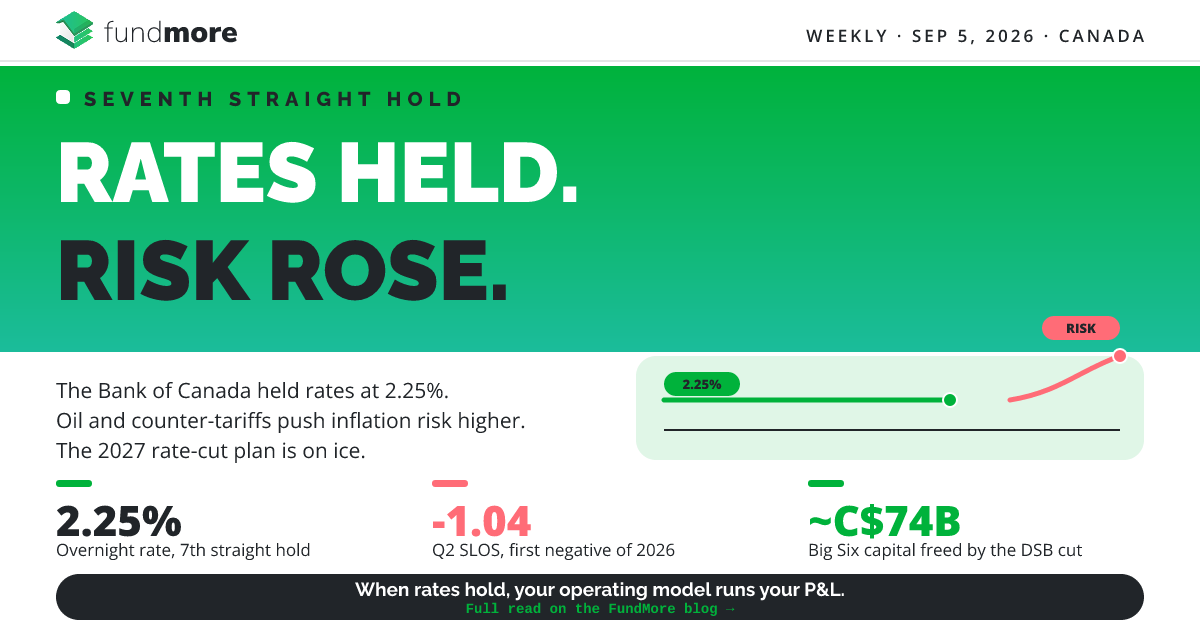
On September 3, 2026, the Bank of Canada held its target for the overnight rate at 2.25%, with the Bank Rate at 2.5% and the deposit rate at 2.20%. It was the seventh consecutive hold, extending a pause that started when the Bank cut to 2.25% in October 2025. Governor Tiff Macklem confirmed the July Monetary Policy Report call for a "broadening recovery" in the economy - but framed inflation as the risk moving fastest. "Oil prices are back up," Macklem told reporters in Ottawa. On tariffs, he was blunter: "The counter-tariffs, and indeed the US tariffs will add costs for some businesses. These tariffs are very steep, but they are applied to a relatively narrow base." The war in the Middle East, he added, is the "bigger issue" for inflation.
The report
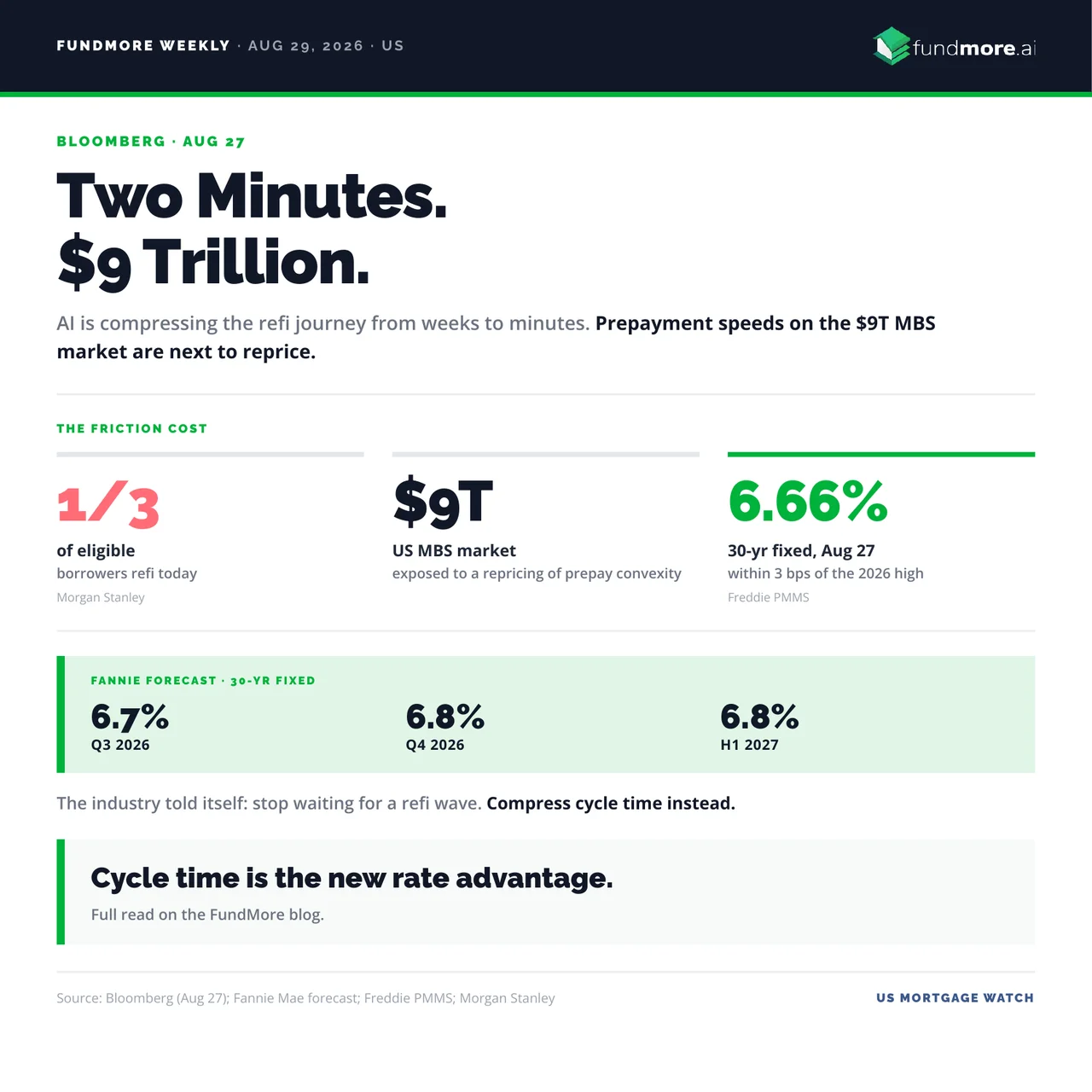
On August 27, 2026, Bloomberg published a piece arguing that AI will help homeowners whose loans are ripe for refinancing secure new, cheaper loans "far faster." The reporters cited Morgan Stanley research showing that when rates fall, only about one-third of homeowners who could save meaningfully by refinancing actually do so - largely because the process is "notoriously drawn-out and tedious." The stated implication: faster refis will squeeze investors in the $9 trillion US mortgage bond market.
Two data points, one customer
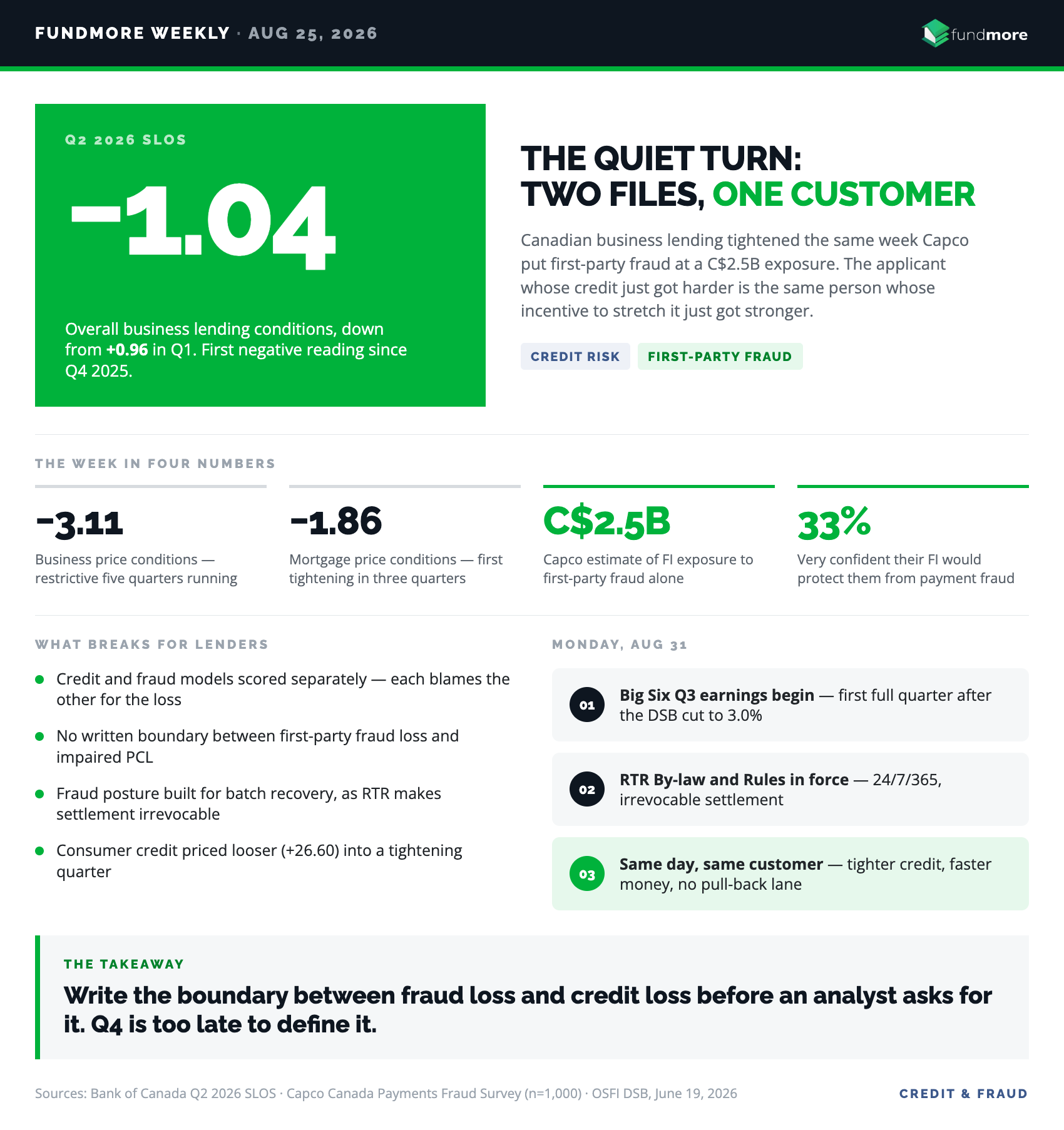
Two Canadian financial data points landed within 24 hours of each other last week, and read side by side they say something the individual releases don't. On Thursday, the Bank of Canada published its Q2 2026 Senior Loan Officer Survey, and overall business lending conditions moved to a balance of -1.04 (tightening) from +0.96 in Q1. It is the first negative reading since Q4 2025. On Wednesday and Thursday, Capco published a fresh Canada Payments Fraud Survey and a companion analysis on first-party fraud, together putting a C$2.5B working estimate on Canadian FI economic exposure to first-party fraud alone.
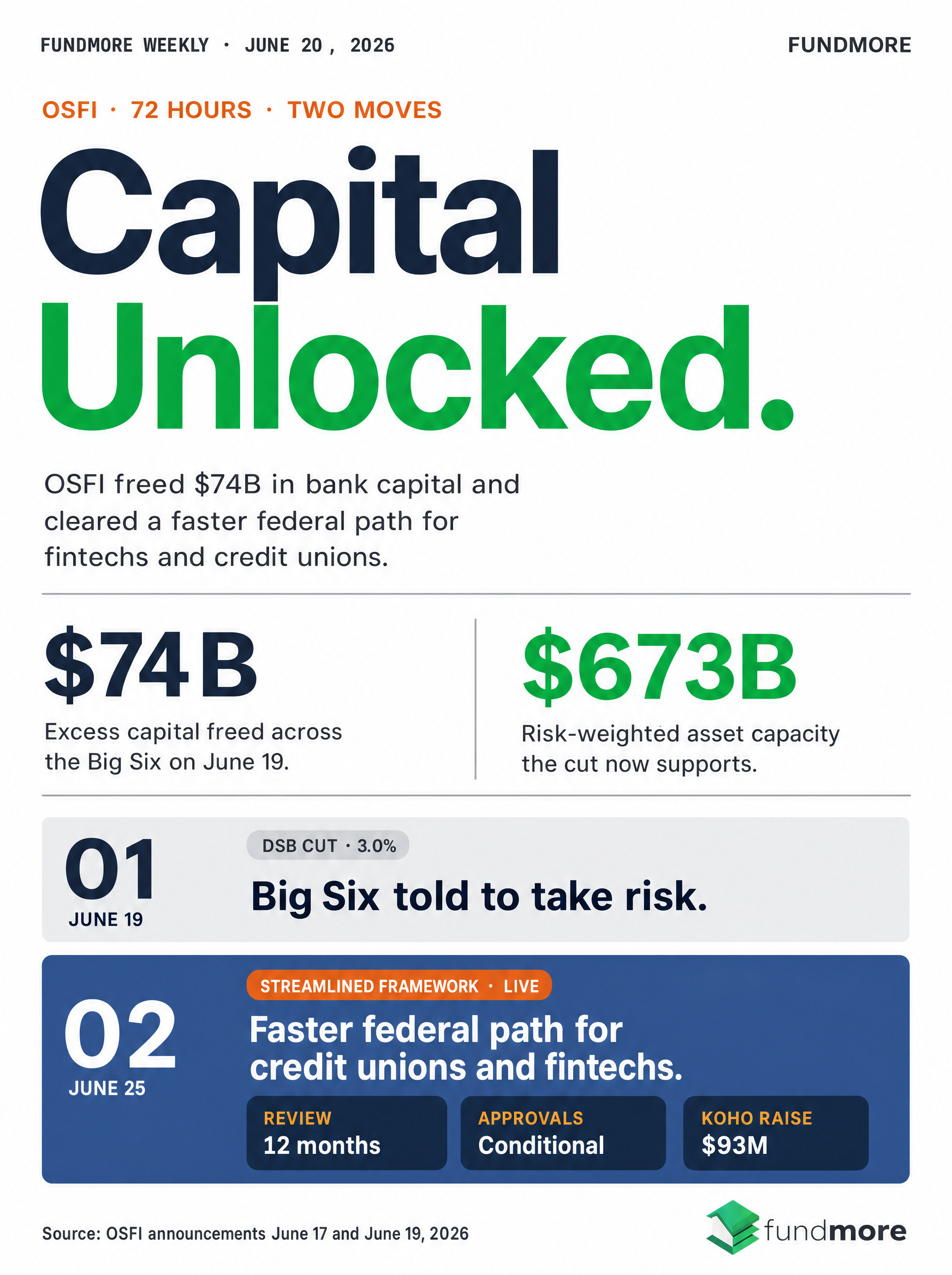
In seventy-two hours, OSFI made two announcements that, taken together, reshape the competitive structure of Canadian lending for the rest of the decade. On Wednesday, June 17, the regulator confirmed that its Streamlined Framework launches on June 25, creating a faster, more predictable path for provincially regulated credit unions to continue operating as federal credit unions and for fintech “innovators” to become federally regulated deposit-takers. On Friday June 19, OSFI cut the Domestic Stability Buffer to 3.0% from 3.5%, the first move in three years, freeing approximately $74 billion in excess capital across the Big Six and supporting up to $673 billion in additional risk-weighted asset capacity. One regulator. One week. Two levers are pulled in opposite directions, both pointing at the same conclusion.