Two data points, one customer
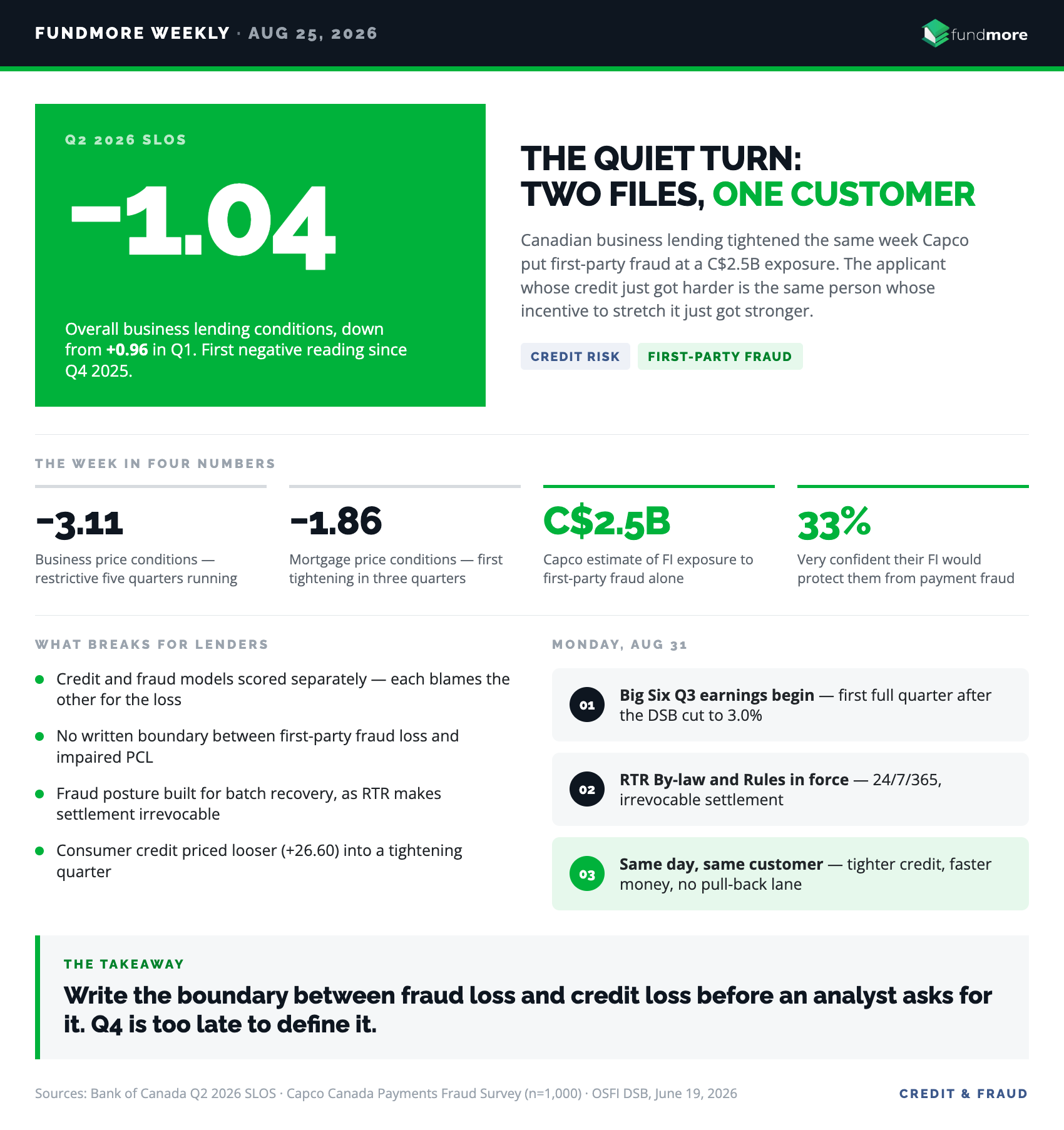
Two Canadian financial data points landed within 24 hours of each other last week, and read side by side they say something the individual releases don't. On Thursday, the Bank of Canada published its Q2 2026 Senior Loan Officer Survey, and overall business lending conditions moved to a balance of -1.04 (tightening) from +0.96 in Q1. It is the first negative reading since Q4 2025. On Wednesday and Thursday, Capco published a fresh Canada Payments Fraud Survey and a companion analysis on first-party fraud, together putting a C$2.5B working estimate on Canadian FI economic exposure to first-party fraud alone.
The overlap between those two files is a customer. Someone whose credit conditions just got harder is also someone whose incentive to dispute a legitimate charge, misreport income on an application, or lean on friendly fraud tactics just got stronger. If your models score credit and fraud separately, they will each blame the other; if you don't score them together, both will underestimate the loss.
What the SLOS actually says
Under the hood, the Q2 SLOS shows a Canadian lending environment moving in different directions at the same time. On the business side, conditions tightened for the first time this year:
- Overall business lending balance: -1.04 in Q2 vs +0.96 in Q1
- Business price conditions: -3.11 (restrictive) for the fifth consecutive quarter
- Business non-price conditions: +1.04, down sharply from +5.03 in Q1
On the household side, the direction depends on the product.
- Mortgage price conditions: -1.86, the first tightening in three quarters
- Mortgage non-price conditions: +3.14, still gently loosening
- Non-mortgage household price conditions: +26.60, a sharp loosening from 0.00
- Non-mortgage household non-price conditions: +0.12, essentially flat
The most interesting story in that table is the household split. Banks priced mortgages more tightly, priced consumer credit substantially more loosely, and left non-price conditions roughly where they were. Read as a portfolio-management move, it's coherent: pull back on renewal-season mortgage pricing where you can see the risk on your own book, and lean into consumer credit price competition where you're chasing engagement and cross-sell. Read alongside the fraud data below, it's a bit more concerning.
What Capco just put on the table
Capco's Canada Payments Fraud Survey, based on a 1,000-adult Canadian sample, is the sharper of two data points; the first-party fraud follow-up is the more expensive one. Headline numbers:
- 91% of Canadians fear their online data could be used to enable impersonation or expose security answers
- 36% experienced attempted payment fraud in the previous two years
- 45% flag card/card-data theft as a top concern, 45% identity theft, 41% account takeover
- Only 33% are very confident their primary FI would protect them from payment fraud
- 52% either weren't told about deepfake payment threats by their FI, or can't recall being told
- C$2.5B working estimate of Canadian FI economic exposure to first-party fraud alone (deliberate credit misuse, dispute abuse, account misuse, associated operational cost)
The Paypers captured the broader takeaway from the Capco data: Canadian consumers cite data security as their top fraud concern, rather than transaction speed or convenience. That matters because the RTR comes into force this week, and the entire consumer sell for RTR is speed and convenience. Consumer preferences are running slightly behind the rail we're activating.
Why these are the same story
The connective tissue is behavioural. First-party fraud (the Capco C$2.5B figure) is the fraud category that expands fastest under credit stress. When applicants stretch their income on an application, dispute a legitimate charge to buy time, or misuse an approved line, they are responding to the same conditions that the SLOS describes. Tighter business conditions and consumer credit pricing that's suddenly looser will together increase both the incidence of first-party fraud and the ambiguity between fraud loss and credit loss.
That has three practical implications for a Canadian lender's stack.
Your PCL ratio depends on where you draw the line
If your ops teams classify a dispute-abuse loss as fraud, it lives in fraud-and-op-loss. If they classify it as credit misuse, it lives in impaired PCL. In a tightening quarter, that classification decision can move headline PCL enough to matter to analyst commentary. Every FI reporting next week has this problem; the ones with a written definition of the boundary before Q4 will look more credible than the ones patching it in real time.
Your fraud policy is a credit-underwriting input
First-party fraud detection is not a downstream monitoring function; it is an upstream underwriting signal. Pattern-of-life data on how an applicant behaves during application, how they respond to knowledge-based challenges, and how they use approved lines in the first 30 days is credit-relevant information that most Canadian FI stacks silo out of the credit decision. Bringing it back in - carefully, and inside the model risk framework - is the more defensible response to a C$2.5B first-party number than adding another fraud rule.
Your customer-communication strategy is a retention lever
Fifty-two percent of Canadians can't recall being told anything about deepfake payment threats by their FI, and only 33% are very confident about protection. In a market where RTR is about to make every payment irrevocable, the FIs that publish a clear, plain-English fraud-defence story over the next two quarters will earn attention and retention. The ones that don't will keep the customers who don't shop and lose the ones who do.
How this ties into the rest of the Canadian regulatory board
Three larger pieces frame these two data points. First, OSFI cut the Domestic Stability Buffer from 3.5% to 3.0% on June 19, freeing billions in D-SIB capital. That capital is available for lending, and Q3 earnings week will be the first full quarter reflecting it. Second, Canada's Real-Time Rail By-law and Rules come into force this week, making irrevocable, 24/7 settlement legally live and pushing every FI's fraud posture from batch recovery to real-time prevention. Third, Big Six earnings start Monday and will set the tone for how Canadian executive teams talk about deploying freed capital in a lending environment that has just tightened.
Read together, the story is not "lending is bad" or "fraud is worse." It is that the Canadian FI stack is being rewired on multiple layers at once (rails, capital, credit conditions, customer trust) and the coherence between those layers matters more than any single lever.
Three lenses that keep working under a turning credit environment
Policy is the moat, not the model
When credit conditions tighten, the value of a well-versioned credit policy compounds. Two Canadian lenders with the same third-party model will produce different books because they apply different corrections and manual overrides. Capturing those adjustments as a versioned, auditable policy - separate from the model - is how a lender preserves institutional judgment across cycles instead of relearning it every downturn.
Digital twins beat data pools
Stress-testing a book against a specific tightening scenario, or against a specific first-party fraud vector, is a lot easier if you can run it on a privacy-safe digital twin of your own portfolio rather than a shared pool. It also keeps you clean against PIPEDA, Law 25, and OSFI B-10 - which will matter more, not less, as consumer trust in data handling continues to shape retention.
Build on existing infrastructure, not rip-and-replace
The response to a turning SLOS quarter is not a new LOS. It is a set of intelligent decisioning and fraud agents that sit on top of the existing stack, capture the corrections underwriters and analysts are already making, and expose them as auditable outputs. That is how you tighten policy in a controlled quarter, not a scramble.
What to actually do in the next 30 days
- Ship a written boundary between first-party fraud loss and credit loss. Get the definitions out of individual ops-team heads and into a document the CFO's team can defend to analysts.
- Run a portfolio-level review of segments where non-price conditions are still loosening. Ask which of them are also over-indexed on first-party fraud rate.
- Draft a customer-facing fraud communication for the next 90 days. Plain language. Include deepfakes. Publish before someone else does.
- Prepare a Q3 talk track. Assume investors and analysts will ask about deployment of the freed DSB capital against a tightening SLOS and against the C$2.5B first-party number. If you don't have an answer, expect the question to keep repeating.
The bottom line
The SLOS turn is small in size and large in signal. The Capco data is not new in kind but is fresh in size, particularly the C$2.5B first-party number. Neither is a headline that will drive a stock price. Both are the kind of quarterly data point that separates FIs that hold institutional judgment across cycles from FIs that discover it the hard way.
Q3 earnings starts Monday. RTR By-law and Rules come into force the same day. The lenders whose fraud, credit, and customer-communication stories are already the same story will make the next six weeks look easy. The rest will spend Q4 patching the seams.
Frequently Asked Questions
What did the Q2 2026 Senior Loan Officer Survey actually show?
Overall business lending conditions moved to a balance of -1.04, from +0.96 in Q1, the first negative reading since Q4 2025. Business price conditions stayed restrictive at -3.11 for the fifth consecutive quarter, and business non-price conditions eased from +5.03 to +1.04 (near neutral). On the household side, mortgage price conditions turned negative (-1.86) for the first time in three quarters while non-mortgage household price conditions moved sharply looser to +26.60. The full data tables are in the Bank of Canada's SLOS publication.
Is a -1.04 SLOS balance a big move?
Not in absolute size; it's small. What matters is the sign change. The SLOS is a directional survey; a move from +1 to -1 is telling you that more banks are tightening than loosening, for the first time in two quarters. In a survey that had been signaling easing all year, that direction change is the signal, not the magnitude.
What is first-party fraud and why is Capco pegging it at C$2.5B?
First-party fraud is fraud committed by an accountholder or applicant themselves rather than an outside impersonator. It covers deliberate credit misuse, dispute abuse ("friendly fraud"), account misuse, and the associated operational cost. Capco's working estimate of C$2.5B in Canadian FI economic exposure spans those four categories, and expands under credit stress because the incentive to abuse existing credit or disputes rises when other options tighten.
How should a lender split first-party fraud loss from credit loss in PCL?
There is no single right answer, but there is a defensible one for a given FI. The point is to have it in writing, applied consistently, and understood by finance, risk, ops, and IR. Q3 analyst commentary is a plausible forum for one of the Big Six to disclose their approach publicly; smaller lenders should have their internal answer before that happens.
How does this affect renewal-season mortgage strategy?
Mortgage price conditions turned negative in Q2 for the first time in three quarters. Combined with non-price conditions still gently loosening, banks are quietly repricing mortgage risk without changing headline underwriting posture. Renewal-season strategy should assume more differentiation on price by segment, not less.
What should we watch in Q3 bank earnings?
Three axes. How banks are deploying capital freed by the June DSB cut from 3.5% to 3.0% (buybacks vs lending vs tech). How they are framing impaired PCL versus operational and fraud loss in a quarter where the SLOS just turned. And how they are talking about internal AI productivity gains - Scotia and CIBC have set the internal-agent narrative bar.