The rate era is quietly ending. The advice era is quietly beginning.
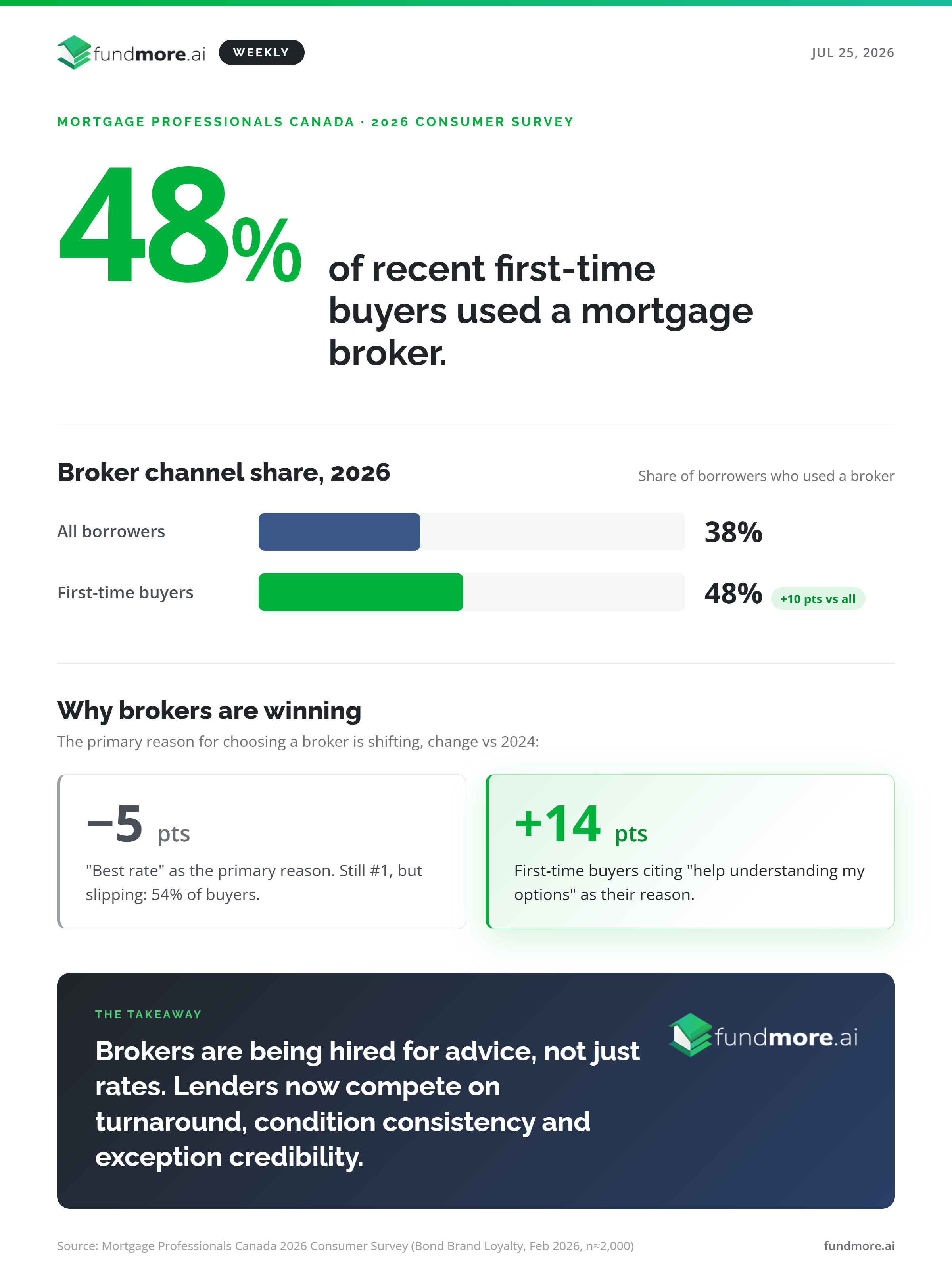
On July 24, Mortgage Professionals Canada released the 2026 Consumer Research Report, fielded by Bond Brand Loyalty across close to 2,000 Canadians in seven cities between February 5 and 25. The two headline numbers: broker channel share reached 38% overall, and 48% among recent first-time buyers. Those are not incremental moves; among first-time buyers, broker use is now within a rounding error of tied with the direct-to-lender channel that Canadian banks have owned for decades.
Under the headline is a more interesting migration. Access to the best rate is still the number-one reason Canadians say they use a broker (54%), but that motivation dropped five percentage points from 2024. Meanwhile, 33% cited getting multiple quotes; 31% cited help understanding options and the mortgage process; 26% cited recommendations on which lender to deal with. Among first-time buyers, 40% said they used a broker to understand their options and the process, up 14 points from 2024. Rate is not disappearing as a reason; it is being outgrown by advice as the reason.
What Lauren van den Berg is actually saying
MPC's president framed the survey plainly: "Canadians are facing more complex mortgage decisions than they were a few years ago, from rate selection to lender choice to long-term affordability. This research shows that mortgage brokers are increasingly being recognized not only for access to competitive rates, but for the advice and guidance they provide throughout the process."
She has been saying the same thing internationally. At The Adviser Growth Summit this week in Australia, van den Berg described Canada as "a small but mighty industry" at 35-ish per cent share, and warned brokers on both continents that "standing still is no longer an option" as differentiation moves from rate access to professional advice. The MPC survey and the Australia panel are the same argument told twice; the channel that wins the next decade is the one that professionalizes into advice, not the one that stays on rate boards.
Why this matters more than the number itself
First-time buyers are the highest-value customer any lender underwrites. That first mortgage typically anchors a 15-30 year household relationship: renewals, refinances, HELOCs, chequing accounts, credit cards, small-business loans, wealth conversations, eventually the next generation's first mortgage. Losing a first-time buyer at origination is not losing one deal; it is losing an annuity to whoever the broker recommended.
The volume environment sharpens the point. CMHC's July 22 mid-year update cut existing home sales ~7% to 457,000 for 2026 and lowered the average price forecast 3.3% to $675,200. The Bank of Canada held at 2.25% for a sixth straight decision on July 15; MPC's own earlier renewal-buffer research flagged how thin household payment buffers have become. In a lower-volume, higher-complexity market, the broker's advice role is not a marketing story; it is a survival function for households making harder decisions with less margin for error. Lenders that treat the channel as a rate-comparison funnel will keep losing files they think they should have won.
What the broker actually cares about (that most lenders miss)
If the broker's value to the client is professional advice, the broker's value to the lender is throughput they can trust. That reduces to a small number of things a broker measures every day, even if they never write it down.
- Underwriting turnaround at the 90th percentile. Not the median; the 90th. A three-hour average with a two-day tail loses more files than a five-hour average with a six-hour tail.
- Condition consistency across underwriters. If the same file returns different conditions depending on who catches it, the broker cannot promise anything to their client. They will submit to someone who can.
- Exception credibility. When a reasonable ask escalates, does the answer arrive on the same day and match what the BDM said policy would allow last month? Coin-toss exception handling is where broker trust dies quietly.
- Portable knowledge. Can the broker learn your policy well enough to pre-qualify their own clients? The lender whose policy fits in a broker's head is the lender they submit to first.
- Post-fund behaviour. What the servicing experience feels like six months in ends up on the broker's next client call. Retention conversations happen in Coffee Bean, not in your Salesforce.
Three lenses that hold up in a broker-heavy market
Regardless of vendor or stack, three principles keep working when the broker channel is doing the advising and the lender is competing on behaviour rather than rate.
Policy is the moat, not the model. The specializing signal in every lending decision is the lender's own credit policy and the corrections their underwriters make to it, not the foundation model beneath any AI tool. When that signal stays with the lender, condition consistency and exception credibility both improve, because the same rules apply to the same files across underwriters and across files.
Digital twins beat data pools. Privacy-safe, model-derived synthetic data lets a lender pressure-test a policy change, a rate move, or a channel-mix shift against realistic borrower cohorts before the broker channel notices any of it. That satisfies PIPEDA, Quebec's Law 25 and OSFI B-10 without moving raw borrower records around, and it lets policy evolve without ambushing brokers mid-submission.
Build on existing infrastructure, not rip-and-replace. Agents that sit on top of the LOS a lender already runs are much easier to inventory and audit under the OSFI agentic AI bulletin, and they preserve the workflows brokers and BDMs are already fluent in. Ripping and replacing a functioning broker channel to modernize its plumbing is a self-inflicted market share problem.
None of the three principles are exclusive to FundMore; they are lens choices any Canadian lender can adopt. They just happen to line up cleanly with what brokers say they need from a lender in 2026.
The next 90 days
Do the top-20 broker exercise. Measure 90th-percentile time to condition, cross-underwriter consistency and exception credibility. Where the numbers embarrass you, fix the process before you fix the marketing. Brokers are quietly ranking Canadian lenders every week; the ranking will show up in your Q4 originations whether or not you looked at it in Q3.
As KOHO's $93M raise this week and the ongoing consolidation into rated, well-capitalized challengers make clear, the competitive set for first-time buyers is not standing still either. The broker channel is the leading indicator; the mortgage book is the lagging one.
Frequently Asked Questions
What did the MPC survey actually measure?
Mortgage Professionals Canada's 2026 Consumer Research Report is a 20-minute online survey of close to 2,000 Canadians across seven cities, fielded by Bond Brand Loyalty between February 5 and February 25, 2026. Full details are in MPC's release via Yahoo Finance/CNW.
Is 38% broker share a record?
It is the highest MPC figure widely reported in recent years, and van den Berg herself used a lower "35-ish per cent" number as recently as this week when describing Canada internationally. Whether one prefers 35% or 38%, the direction of travel is up and the first-time buyer number has moved decisively.
Why are first-time buyers particularly moving to brokers?
40% of recent first-time buyers cited "help understanding options and the mortgage process" as their reason for using a broker, up 14 percentage points from 2024. First-time buyers are facing more product complexity, tighter affordability, and higher decision stakes than seasoned homeowners; they are hiring brokers as advisors, not just as rate-shoppers.
Does higher broker share mean lower lender margin?
Not automatically. It means competition moves off posted rate and onto operational behaviour: turnaround, condition consistency, exception handling, and policy fluency at the broker level. Lenders that invest in those tend to hold margin and grow share simultaneously; lenders that compete only on rate compress both.
What is the single most useful metric to start tracking?
90th-percentile time-to-condition on submitted deals, segmented by broker firm. It correlates with broker perception more tightly than median turnaround and is a leading indicator of channel share within twelve months.
How does this connect to the OSFI agentic AI bulletin?
Directly. OSFI's July bulletin expects lenders to know what every AI agent in their stack is authorized to do, and to keep an accountable human on material decisions. That discipline is exactly what makes an underwriting workflow consistent enough for a broker to trust; the governance work and the channel work end up being the same work.