The date the batch era ends on paper
On Monday, August 24, 2026, Canadian Payments Association By-law No. 10 and the RTR Rules come into force. It is one of those regulatory events that will feel administrative on the day and structural in retrospect. The by-law is the foundational legal framework for Canada's Real-Time Rail, the new 24/7/365 exchange, clearing and settlement system that supports instant, irrevocable, data-rich account-to-account payments.
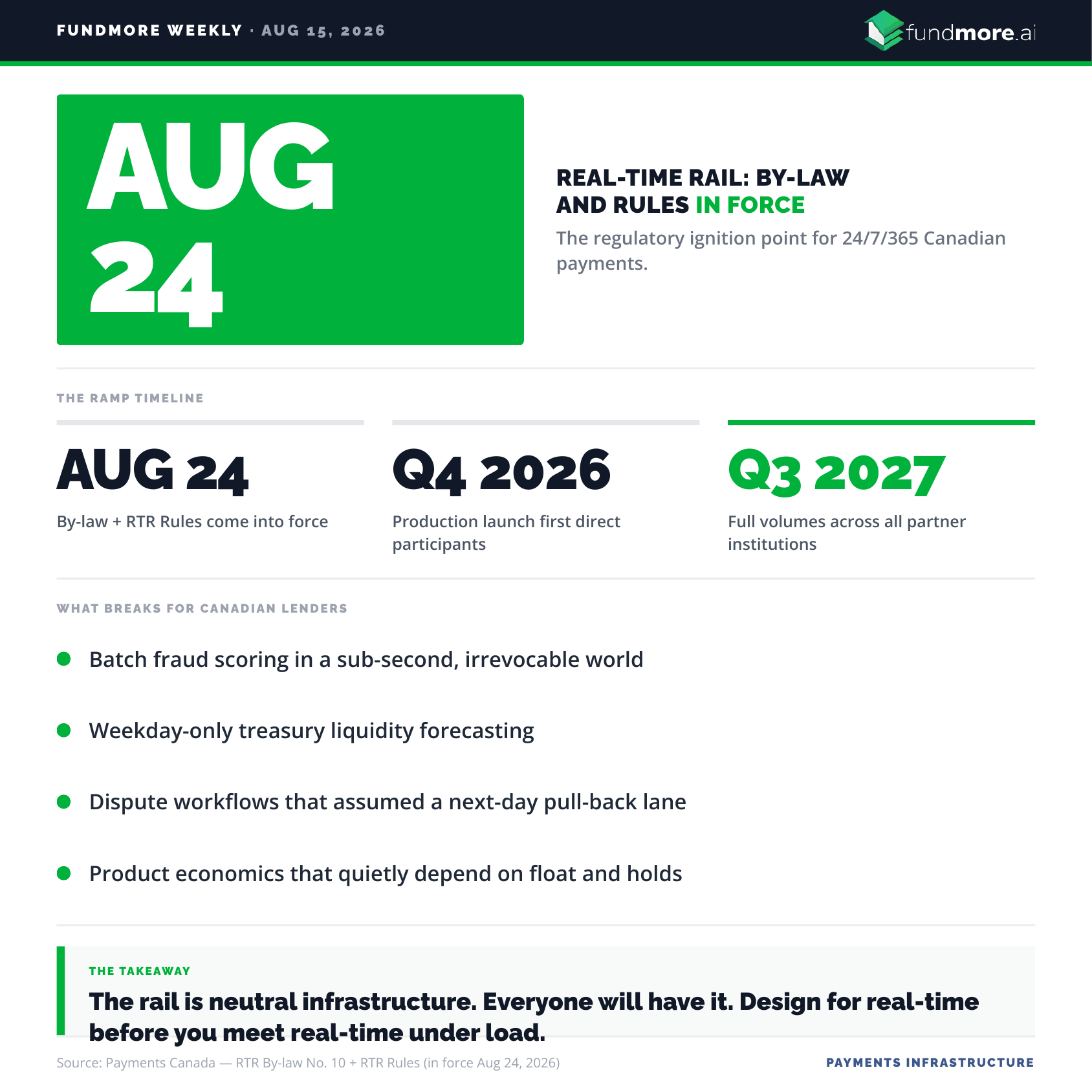
Nothing goes live for consumers on August 24 itself. Production launch remains scheduled for Q4 2026, with initial direct exchange participants entering production first. Interac e-Transfer clearing and settlement migration begins in the first half of 2027, and Payments Canada estimates full transaction volumes across all partner institutions by Q3 2027. So the operational ramp is roughly a year long. The strategic timer, though, starts Monday.
What actually changes when RTR is live
Three properties of RTR matter more than the rest, and each of them quietly breaks an assumption baked into most Canadian financial services stacks.
Instant settlement, not overnight batch
The current default is next-business-day settlement, sometimes better with Interac e-Transfer, often worse across corporate cash management. RTR flips that default: funds move and settle in seconds, in production, on every calendar day. It is not "faster batch." It is not batch at all.
Irrevocable, not "you can reverse it Monday"
RTR payments are irrevocable once accepted. There is no next-day chargeback lane for a wire that should not have gone. Every fraud, dispute, and error-recovery workflow that assumes some form of pull-back stops working the way it used to. The controls have to move to the front of the transaction, not the back of it.
24/7/365, not "business hours plus a batch window"
Consumers and businesses can send and receive at 2:14am on Boxing Day. Fraud teams, ops teams, and settlement teams need coverage that assumption. So do the systems, dashboards, and alerting rails behind them.
Add the ISO 20022 payload standard and the mandatory participation in centralized fraud services, both required for access, and RTR is not just a faster pipe. It is a richer, more governed, permanently-on pipe.
What breaks in a Canadian lender's stack (if you don't do the work)
Fraud stacks that assumed batch scoring
A meaningful share of Canadian fraud controls run some version of overnight scoring, batch model refreshes, or same-day-but-not-real-time review queues. In an irrevocable, sub-second world, batch scoring is decorative. Real-time model inference on real-time features is not an aspirational item in a three-year roadmap; it is the minimum operating condition of an RTR-connected product.
Treasury desks that assumed weekday liquidity
Weekend and overnight liquidity forecasting quietly assumed that payment flows sat still outside settlement hours. That is no longer true. Corporate and commercial customers will start expecting instant outbound flows on holidays; treasury needs to model that as normal-course, not exceptional.
Dispute and collections workflows that assumed pull-back
Once payment is irrevocable, dispute resolution moves upstream. That means better payee verification, better payer authentication, better "are you sure?" moments in flow, and better first-line recovery outside the payment rail (agreements, indemnities, letters of intent). It also means updating collections playbooks to reflect that funds gone via RTR are, functionally, gone.
Product surfaces that assumed slow money is a feature
Some Canadian consumer and small-business product economics quietly depend on float, holds, and the friction of slow money. RTR does not remove them all at once, but it changes customer expectations quickly. The bank or lender still doing 3-5 business day holds in 2028 will not be positioned favourably next to a competitor moving funds in seconds on the same regulated rail.
What the RTR actually opens up for lenders (and where credit gets more interesting)
The most useful way to read RTR is not "payments got faster" but "a new class of lending products just became possible."
Funding-at-approval
Line increases, HELOC advances, and revolving credit top-ups can settle to a borrower's account in seconds, not days. The application-to-cash gap collapses. That has downstream implications for how underwriting decisions are staged: the customer's expectation of instant funding requires that credit models, verifications, and policy checks be completed within the same session, not overnight.
Payroll on-demand and disbursement-at-decision
Payroll, gig payouts, insurance claim payments, and mortgage renewal cashbacks all become genuinely instant on a regulated Canadian rail rather than through workarounds. Insurers, lenders, and fintechs that lean into this in 2027 will start defining new baselines for CX.
Request to Pay and richer bill payments
ISO 20022 payloads and messaging capabilities enable Request-to-Pay-style flows, giving billers and lenders a two-way conversation with the payer within the payment itself. That is a substantially better collections experience than pushing a static Interac e-Transfer email and hoping.
Real-time commercial cash management
Commercial banking customers care about intraday liquidity more than most retail products do. RTR unlocks intraday sweeps, instant supplier payments, and dynamic working-capital arrangements that were mechanically impossible on batch rails. The banks that build for that use case will keep commercial share; the ones that don't will lose it to non-bank spend management platforms already positioning in Canada.
How RTR intersects with everything else on the Canadian regulatory board
RTR does not arrive in isolation; it lands on top of a Canadian financial infrastructure that is being rebuilt in public. The Consumer-Driven Banking framework is close to final regulation, with the consultation on the draft rules closing Aug 26 and implementation targeted for within one year of Gazette Part II publication. Payments Canada is sunsetting paper PADs by December 1, 2028, which forces every biller and lender still on paper PADs to move to modern rails. And OSFI's agentic AI bulletin makes it clear that regulated FIs need to inventory and account for autonomous agents in their stack, some of which will inevitably initiate or authorize real-time payments by 2027.
Read together, the four pieces (RTR, CDB, paper PAD sunset, agentic AI accountability) point at a single implementation reality for Canadian lenders: the operating environment expects real-time, data-rich, permissioned, auditable, agent-friendly financial workflows by the end of 2027. The choice is whether you build for that environment now or retrofit for it in 18 months under pressure.
Three lenses that keep working under RTR
Policy is the moat, not the model
The RTR rail is neutral infrastructure. Everyone will have it. What differentiates a lender's real-time fraud, credit, and dispute decisions is the lender's own credit policy plus the corrections its underwriters and fraud analysts make to model outputs. That specializing signal, captured versioned and used to train the lender's own agents, is what separates a real-time "yes" that ages well from a real-time "yes" that becomes tomorrow's loss.
Digital twins beat data pools
Every lender preparing for RTR needs to test how new instant products behave under stress: fraud spikes, weekend volume surges, model drift on 24/7 flows. Privacy-safe digital twins of a lender's own book let strategy pressure-test those scenarios without moving raw customer records, and stay compliant with PIPEDA, Law 25, and OSFI B-10. That is a substantially faster route to a defensible go-live than reasoning about it in a spreadsheet.
Build on existing infrastructure, not rip-and-replace
The RTR is being connected to LOSs, core banking systems, and commercial platforms that are already running. Ripping and replacing those under a Q4 2026 go-live is a self-inflicted risk. Real-time credit and fraud agents that sit on top of existing systems, expose clean audit trails, and inherit governance from the existing model risk framework are how a lender gets to real-time without breaking what already works.
What to actually do in the next 90 days
Three exercises any COO, head of payments, or CRO can run before the Q4 launch quarter starts:
- The instant-and-irrevocable inventory. Walk your top 20 payment-adjacent workflows and mark each one for how it behaves when settlement is real-time and irrevocable. Fraud, disputes, holds, treasury, collections, product. Everything green is fine; everything yellow needs a 2026 project; everything red needs an executive owner by the end of this month.
- The 24/7 ops test. Run a tabletop exercise that assumes an RTR fraud incident occurs at 3am on Sunday of a long weekend. How fast does the fraud team engage; who has authority to freeze which controls; what customer communication triggers; what regulator notification triggers. If the answer includes waiting for Monday, the readiness gap has a size.
- The product opportunity list. Ask your commercial and retail product leads to name three products they would ship in the next 12 months if instant, irrevocable, 24/7 settlement were assumed. Do not accept the answer "we can already do this with e-Transfer." Force the exercise. The best three become your competitive differentiation in 2027.
The bottom line
The RTR is a decade-long project that has finally reached its regulatory ignition point. From August 24 onward, real-time, irrevocable, 24/7 account-to-account payments will be legal, live, and in production within a year. Every operational assumption Canadian lenders were built on now has an expiry date, and the operational assumptions Canadian challengers are building around have a start date.
Design for real-time before you meet real-time under load. The Q4 launch will not wait for anyone's roadmap.
Frequently Asked Questions
What actually happens on August 24, 2026?
The RTR By-law (Canadian Payments Association By-law No. 10) and the RTR Rules come into force. This activates the legal operating framework for the system. It does not activate the system for end users; production launch is targeted for Q4 2026.
What is RTR and how is it different from Interac e-Transfer?
RTR is Canada's new 24/7/365 exchange, clearing and settlement system for instant, data-rich, irrevocable account-to-account payments, running on ISO 20022. Interac e-Transfer today is a messaging-layer product built on batch settlement between banks. Once RTR launches, Interac e-Transfer clearing and settlement will migrate to RTR starting in H1 2027, so the user-facing product may look similar even as the plumbing changes.
When will RTR actually reach full volumes?
Payments Canada expects full transaction volumes among all partner institutions by Q3 2027. The Q4 2026 launch begins with initial direct exchange participants in production; the operational ramp is roughly a year.
Who can participate directly?
Payments Canada members can participate directly. Payment service providers can participate via RPAA registration with the Bank of Canada plus Payments Canada membership, a settlement model, ISO 20022 integration, centralized fraud services, testing and certification. The rules provide the legal framework; access is not automatic.
What does RTR mean for lenders specifically?
Two things. First, existing operating assumptions (batch clearing, weekday settlement, revocable payments) become progressively wrong through 2027. Fraud, disputes, treasury, and collections workflows all need real-time redesign. Second, new lending product classes (funding-at-approval, payroll on-demand, disbursement-at-decision, real-time commercial cash management, Request to Pay) become genuinely possible on a regulated Canadian rail rather than through workarounds.
How does RTR interact with Consumer-Driven Banking?
They are complementary, not the same. RTR is the rail; Consumer-Driven Banking is the data-sharing and permissioning framework. Together they enable payment initiation from third parties acting with consumer consent, though the formal payment initiation regime is a later CDB workstream. Both are meant to arrive as operating baselines by the end of 2027.