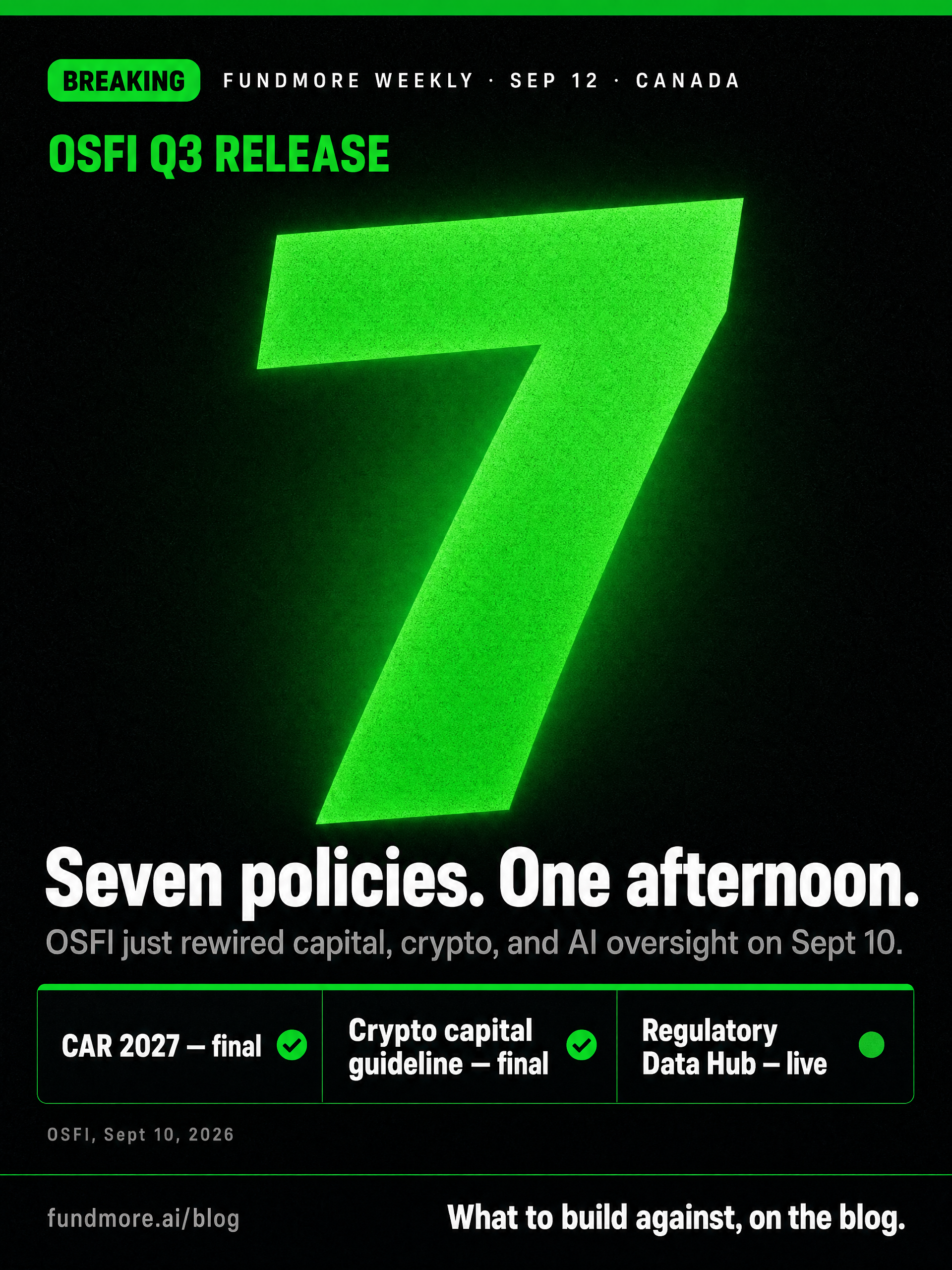
Most Canadian bank leadership teams block a war room around federal budget day and the January economic outlook. Almost none block one around an OSFI Quarterly Release Day. That is starting to look like a mistake. On September 10, OSFI moved simultaneously on capital, crypto, interest rate risk, model governance, AI-driven cyber, and the data platform that will carry every future ask. It is a policy stack, not a policy drop, and the connective tissue matters more than any single guideline.
What actually landed
The Q3 slate, per OSFI's own schedule, included the final CAR 2027 Guideline, the final Capital and Liquidity Treatment of Crypto-asset Exposures (Banking) Guideline (2027), the revised Implementation Note on regulatory capital models, final Guideline B-12 on interest rate risk management, and the Final Mortgage Insurer Capital Adequacy Test on the P&C side. A draft Total Loss Absorbing Capacity Guideline has also entered the consultation phase.
Two items were quietly rescheduled: draft Guideline B-6, Liquidity Principles, moved to February 2027, and the final Pillar 3 Disclosures for Interest Rate Risk moved to the Fourth Quarterly Release on November 19. The Credit Risk Management chapters slid with them. Deferrals in OSFI-land are rarely a signal of relaxation; they usually mean the underlying calibration is still being negotiated.
The three shifts that matter
- CAR 2027 keeps freeing capital for SME lending. OSFI has been consistent that the CAR revisions are meant to “better align capital treatment with underlying risks” and “support increased lending to smaller corporates.” The CAR backgrounder laid the groundwork last year; the 2027 iteration continues it. For lenders with a serious SME book, that is a tailwind. For lenders without one, it is a strategic question.
- The crypto guideline gives Canadian banks a rulebook while the U.S. is still improvising. This is the moat pillar in action. U.S. banks are piloting on public chains and applying for trust charters; Canadian institutions now have a supervisor-endorsed capital and liquidity framework to build against. That is the difference between building a product and negotiating one.
- The Regulatory Data Hub is the story hiding in plain sight. OSFI's Data Collection Modernization initiative starts onboarding banks and insurers to a new corporate data platform this quarter. Filings move into the Hub. That means the marginal cost of every future OSFI ask drops for institutions that own their data, and rises for those that don't.
The AI item you should not miss
Buried in the Industry Day agenda: an AI Accelerated Threat Landscape briefing built with the Canadian Centre for Cyber Security, focused on frontier AI threats and recommended mitigations. OSFI is not asking whether generative AI raises fraud and cyber tail risk; it is putting the frame on the table and pointing at concrete controls. Boards that treated AI as a model-governance issue now have a supervisor-endorsed operational-resilience angle to plan against.
What lenders should do this quarter
- Read the crypto guideline against your current product roadmap, not against your current book. The point is what you can build now, not what you already run.
- Map your SME lending capacity into the CAR 2027 changes. If your credit committee is still calibrating to the old rules, you are giving up growth to the banks that recalibrated first.
- Get onto the Regulatory Data Hub with a clean-data posture, not a copy-and-transform posture. Every filing you patch instead of source will compound.
- Move AI risk into operational resilience. Model risk teams alone cannot own it; treasury, cyber, fraud, and vendor management need seats.
- Block the Nov 19 date. Pillar 3 IRR disclosures and B-2 large exposures land there, and the Credit Risk Management “What We Heard” report tells you what OSFI thinks the industry told it.
The three-pillar read
Policy is the moat. Canadian banks now have clarity on crypto capital, updated CAR, and an interest rate risk framework at a moment when U.S. peers are still improvising. Digital twinning, not data pooling, is what the Regulatory Data Hub effectively rewards; institutions with a clean, sourced digital twin of their balance sheet will file faster and defend better. And OSFI is building on existing infrastructure, not asking the industry to rip and replace, which means the winners are the lenders who can plug in without a two-year IT program.
FAQs
When does CAR 2027 take effect?
OSFI finalized the guideline on September 10, 2026. Implementation timing is set out in the guideline and companion implementation note; institutions should confirm with their supervisory team.
What is the Regulatory Data Hub?
It is OSFI's new corporate-data filing platform. Release 1 begins onboarding federally regulated banks and insurers this quarter. See the Q3 release announcement for the Data Collection Modernization update.
Is the crypto capital guideline aimed at custody, trading, or issuance?
It covers capital and liquidity treatment for crypto-asset exposures held by federally regulated banks, including trading, custody-adjacent, and balance-sheet exposures. The guideline defines exposure categories and calibrates capital charges accordingly.
What moved out of the Q3 release?
Draft Guideline B-6 Liquidity Principles moved to February 2027, and final Pillar 3 Disclosures for Interest Rate Risk moved to November 19, 2026 per OSFI's policy plan letter.
How does the AI threat landscape briefing fit in?
It sits inside operational resilience, not model risk. The framing centres on frontier AI threats to cyber and fraud, with mitigations drawn from CCCS resources. Expect this to inform future guidance rather than a discrete new rule.